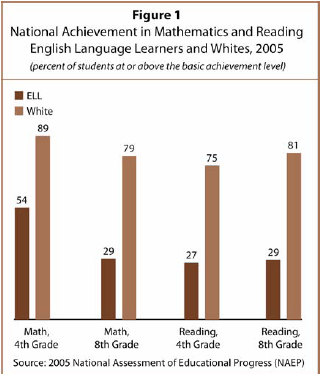
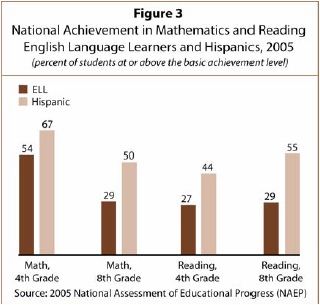
My blog post is meant to illuminate future educators about a very real and growing issue that current teachers are struggling with. English Language Learners are comprising more and more of the standard U.S. classroom, and their needs are drastically different than those of other students. Teachers are asked to teach ELL students, which requires much and on-going education to do effectively, while simultaneously teaching their non-ELL students. ELL’s have the lowest rate of academic achievement and high school graduation rates of all student classifications.
I believe my strengths lie in providing research that paints a very broad picture of the entire issue, and not just focusing on the statistics of the ELL gap. However, I found myself struggling with how to compose and organize the blog, and it felt wrong to structure it like an essay. Do you think I need to restructure my blog, in terms of information and subject matter order? Do I need to include more hyperlinks throughout the body of a paragraph, or is one for each topic enough?
The fastest growing student population is being met with underfunding and a lack of proper teacher training.
All over the United States, English Language Learners are in classrooms that are not geared to provide them adequate education, which is causing them to fall behind. This subject is often labelled as the English Language Learner academic achievement gap. Studies have shown that ELL’s simply do not show the same level of achievement as Non-ELL’s in the classroom setting.
But is it really simple?
Research has shown that it is anything but simple, and to think of the issue as only a gap is a mistake. The achievement gap is not a singular issue, but the product of a multitude of issues. The gap as a consequence has implications that are far reaching in the students lives, the teachers career’s, and the educational policy sphere. So what exactly are these factors that produce the ELL achievement gap, and where do these gaps show up?
Teacher Focus and Student Fluency
One of the main issues contributing to the ELL achievement gap, is the fact that students who are learning the english language, are thrust into normal classrooms and expected to meet the common standards. Due to this, teachers are not focusing their classroom lessons and practices with these students in mind; students who are quickly making up a larger and larger proportion of the classroom. ELL’s who are placed in language immersion classrooms where everything is geared towards them, perform extremely well, as one study found out.
The study found that when placed in language immersion classrooms, the ELL’s performed much better in terms of language fluency than the english speakers with their Spanish fluency. On the other hand, both groups performed the same on standardized tests to measure overall language competency. In terms of fluency attainment, the gap is on the other foot.
There is hope for closing the ELL gap, and that all it takes to make a difference for these students is a little concerted effort in the classroom setting. However, teachers who have ELL’s in their classroom are not and cannot carry out this concerted effort.
Creating Informed and Effective Teachers
Faced with the knowledge that the educational system is failing a large group of students (ELL’s have the lowest rate of graduation amongst all categories of U.S. students), two researchers in 2016 set out to see if teachers could learn how to teach ELL’s. Sadly, by the end of the year long study, the teachers own confidence of awareness and efficacy did not match up with the study’s results. The teachers could not implement effective practices in terms of how ELL’s attain language skills, nor a great deal of ELL instructional practices the educators were taught. This highlights the lack of support for the teachers and the lengthy requirements of learning how to teach ELL’s.
The teachers who are trying their hardest to educate their ELL students, need a greater support staff and more lengthy training. This responsibility largely falls on the lap of educational policy makers, then. It is proven that ELL students who get more funding, do drastically better than those who do not. ELL students who have districts spend over $1000 for each of them, pass an ELL test at a 78% higher rate than districts that spend $300 or less. There is a proven, positive relationship between expenditure per student and their academic achievement. This money goes to the types of things that ELL students need, like properly trained teachers with support staffs, and ELL only classrooms. So if we want ELL’s to do better, we need to draft significant expenditure and teacher support policies.
Emotional and Developmental Consequences
Most teachers never get to partake in the MODELL teaching program though, and they go through their career without knowing how to properly teach a portion of their students. Educational policy has yet to adapt to the growing student body with unique needs. These circumstances have had a deep and lasting psychological effect on how ELL students view education and their own relation to it.
Researchers wanted to look at how ELL’s were coping with the current state of the educational system and their place within it. Unsurprisingly, ELL’s felt like teachers held a great deal of negative power over their lives, unlike non-ELL’s, who felt teachers were there solely to help them. ELL’s consistently stated they felt coerced to conform to the classrooms standards, and picked up on much more negative influences teachers have over them than non-ELL’s did. They also had significantly lower perceived sense of academic competency. All of this, despite the fact that ELL’s and non-ELL’s reported the same levels of educational importance. This means ELL’s know education is extremely important, yet feel they belong to an environment that keeps them from succeeding.
This sense of distress occurs at a much earlier age for ELL’s than expected though. ELL’s are entering kindergarten at earlier ages than many other groups, and this is largely due to a higher rate of poverty for ELL’s; child care programs cost a fair amount of money. This means there are socio-emotional benefits that ELL’s are missing out on due to their earlier enrollment. These effects are purported to wear off by grade 5, but the psychological connections they make to education surely do not. The ELL’s are not as popular and do not perform as well as the other students, especially during the introductory years of their education. Beyond this, we are seeing that there are lasting emotional effects tied deeply to the educational settings for these students later on in their educational career.
Teachers and policy makers need to work together to meet the growing ELL educational needs. The ELL academic achievement gap stems from the standard classroom setting not shifting to meet their needs, a lack of teacher training, and a deep lack of funding. These factors are shown not just to produce the gap, but also cause lasting educational emotional distress for these students. Students can’t learn, and teachers aren’t able to teach until change happens inside and outside the classroom.